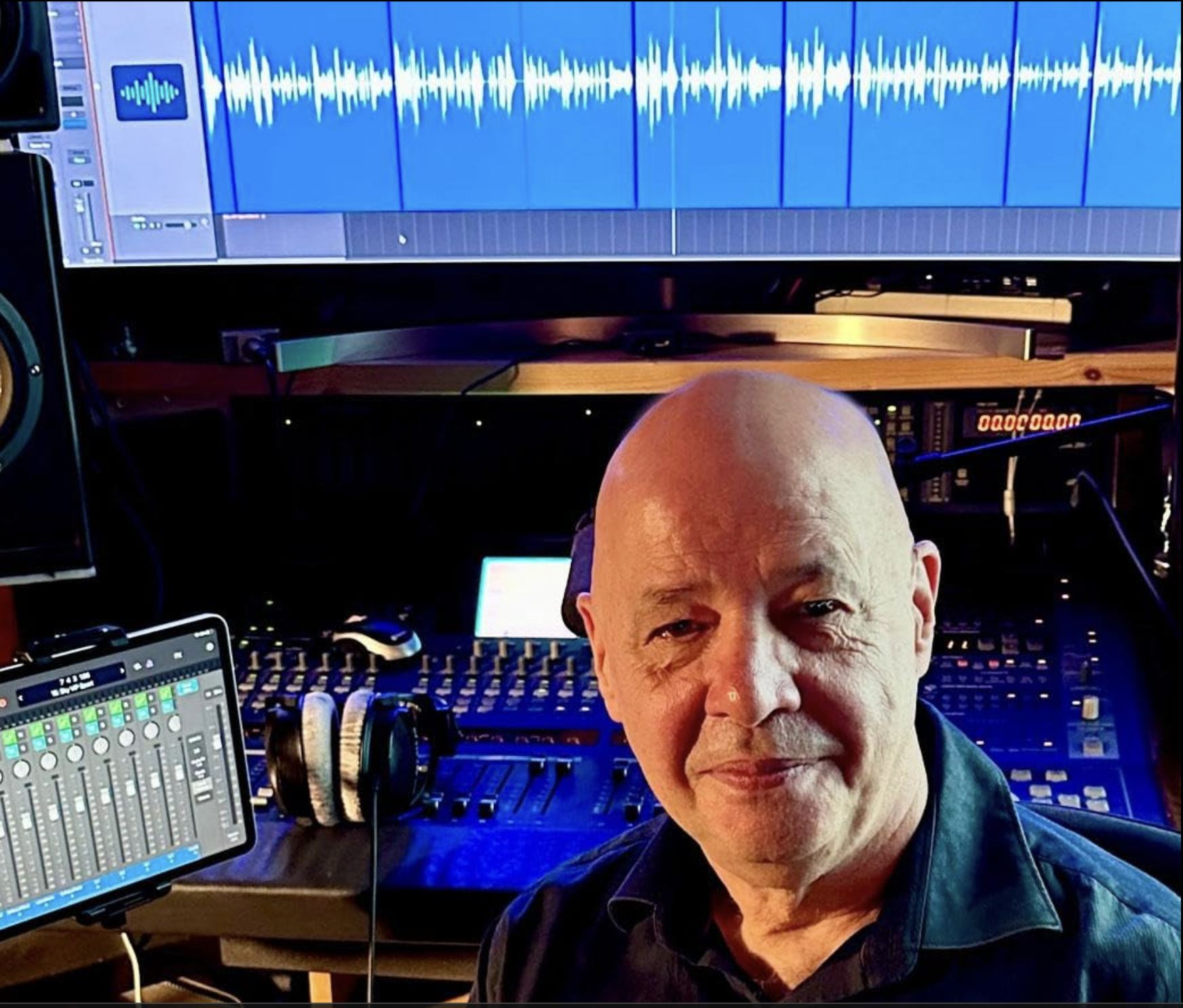
By Iain McKinna, Offbeat Recording Studio, Edinburgh
Nearly every book now comes out as an audiobook, and more and more readers listen rather than read. If you're writing a book, or recording your own audiobook narration, a few choices made at the writing stage can save hours in the studio and make for a far better listen. Here at Offbeat we've recorded many audiobooks by authors narrating their own work, and the same issues come up again and again.
A writer's main concern is still the written word, but it makes sense to create work that holds up across both the page and the ear. None of what follows means writing for the ear instead of the page, most of what helps a narrator helps the reader too.
Long sentences
A very common moment in the booth is when the author says, in an exasperated breath, "I wish I didn't have so many long sentences in my book." They work well enough on the page, but they're not so easy to narrate, especially when they aren't broken up with commas. It can take a few attempts to get one to flow, and when you've a long read ahead of you, that's exhausting. Most authors who hit this in the studio take it into account for their next book.
The best way to catch it at the writing stage is to read your work aloud and edit accordingly. I don't know many publishers who'll commission an edit purely for audiobook purposes, so addressing it on the page is the surest way to avoid the problem later. There may be good creative reasons for a long, comma-light sentence, but they seldom translate to audio.
Err on the side of shorter sentences. You need a variety of lengths to keep things interesting, of course, but consider whether some of your commas could become full stops.
Tonal variation
In works of fiction there's naturally a lot of tonal variation, which keeps things interesting for the listener. In non-fiction it's worth considering how you can build that variation into the script, as long as it stays in context with the subject. A recording with no tonal variation can be exhausting to listen to, so think about where the energy can rise and fall to add light and shade for the listener.
A non-fiction author once came in with a brilliantly researched book, but it was written like a reference document. Page after page of even, level information with no rise or fall. About twenty minutes in, the narrator's read had gone completely flat, not from any lack of skill but because the writing gave them nothing to push against. We stopped, found the points where the author was genuinely excited about their subject, and leaned into those. The difference was night and day. It would have been built in from the start if the writing had signalled where to lift, and in most cases, there simply isn't time to address this in detail during a session.
Another author, after hearing the first chapter back, realised how level it sounded and asked to take the script home overnight. They came back having marked up the points they wanted to emphasise, and the rest of the session had a completely different energy. They'd essentially done the light and shade edit after the fact, which is exactly the work that's better done at the writing stage.
You don't have to wait until you hear the first chapter back. Mark the lifts and the quiet moments as you write, and the light and shade is built in from the start.
Repeated words and tongue-twisters
The eye forgives a word repeated three times in a paragraph. The ear catches it instantly. And a line that looks perfectly fine on the page can be surprisingly hard to say cleanly, especially with unintentional alliteration or an awkward run of consonants. I've re-recorded plenty of lines that simply wouldn't sit in the mouth, no matter how good the narrator. Reading aloud as you write is the quickest way to catch them.
Acronyms, numbers and symbols
Anything on the page that isn't a plain word becomes a decision in the booth. Is it "N. A. S. A." spelled out, or "Nasa" as a word? Is 1985 nineteen eighty-five, or one thousand nine hundred and eighty-five? Does £20m become twenty million pounds? The eye glides straight over these, but in the studio they stop the read dead while someone works out what was meant. If you've a preference, make it clear in the manuscript. It saves real time and keeps the read flowing.
Homographs
These are words spelled the same but spoken differently depending on meaning. Lead the metal or lead the way. Read this now or read it yesterday. A bow in your hair or a bow to the audience. The narrator can easily guess wrong and not realise, which means a pick-up later. Context usually rescues it, but not always, so it's worth being aware of any that could trip the read.
Footnotes, endnotes and parentheticals
These are a visual convention. They don't really exist in audio. A long aside tucked into brackets can derail a spoken sentence completely, because the listener has no way of seeing where it begins and ends. Anything you'd normally drop into a footnote has to either be spoken inline as part of the flow, or left out. Worth deciding which at the writing stage rather than discovering it in the booth.
Character names and invented words
In fiction, particularly fantasy and science fiction, you know exactly how a name sounds in your head. The narrator doesn't. A short pronunciation guide written at the manuscript stage saves a lot of stopping and guessing, and just as importantly it keeps a name consistent across what might be a twelve-hour read. Nothing pulls a listener out faster than a character whose name changes halfway through the book.
He said, she said
In fiction, a narrator voices characters through dialect and accent, so too many "he saids" and "she saids" often aren't necessary when the listener can already tell the characters apart. When I'm directing, I'll sometimes encourage the narrator to drop the ones that aren't earning their place. They can be genuinely distracting when you're trying to follow the plot. In some cases this needs publisher approval, but I've never had a recording come back for pick-ups because I left an unnecessary tag out.
There's another side to this, though. Cutting the tags that aren't needed is one thing, but a long back-and-forth between two characters with no tags at all can lose the listener completely. On the page there's a line break for every new speaker to guide the eye. In audio there isn't, so an exchange that runs too long without a single "she said" can leave the listener unsure who's speaking. It's not simply cut the tags, it's cut the ones that aren't earning their place and keep the ones that are.
The simplest habit of all
None of this means writing for the ear instead of the page. The book still has to work as a book. But the two aren't in conflict as often as you'd think, and most of what helps a narrator also helps the reader. A sentence that's easy to say aloud is usually easy to read. A name that's clear in the booth is clear on the page.
The simplest habit to take from all this is to read your work aloud as you write it. Not once at the end, but as you go. You'll hear the long sentences that need breaking, the names that trip you up, the lines that won't sit in the mouth. Your future narrator, even if that narrator is you, will thank you for it.
After many years of recording I can tell you the books that translate best to audio are almost always written by authors who listened to their own words along the way.
Recording your own audiobook? Offbeat is a high-end audiobook recording studio in central Edinburgh, offering professional narration recording, direction and production — in person or via remote direction. Get in touch to talk about your project.
Iain McKinna is the founder of Offbeat Recording Studio in Edinburgh, where he has spent over fifty years recording and directing audiobooks, ADR and voice work. Productions include The Lonely City by Olivia Laing (narrated by Tilda Swinton) and Nicola Sturgeon's memoir Frankly.